
The Dick Click
Why stories about the so-called “small” lives of women may be the biggest stories of all.

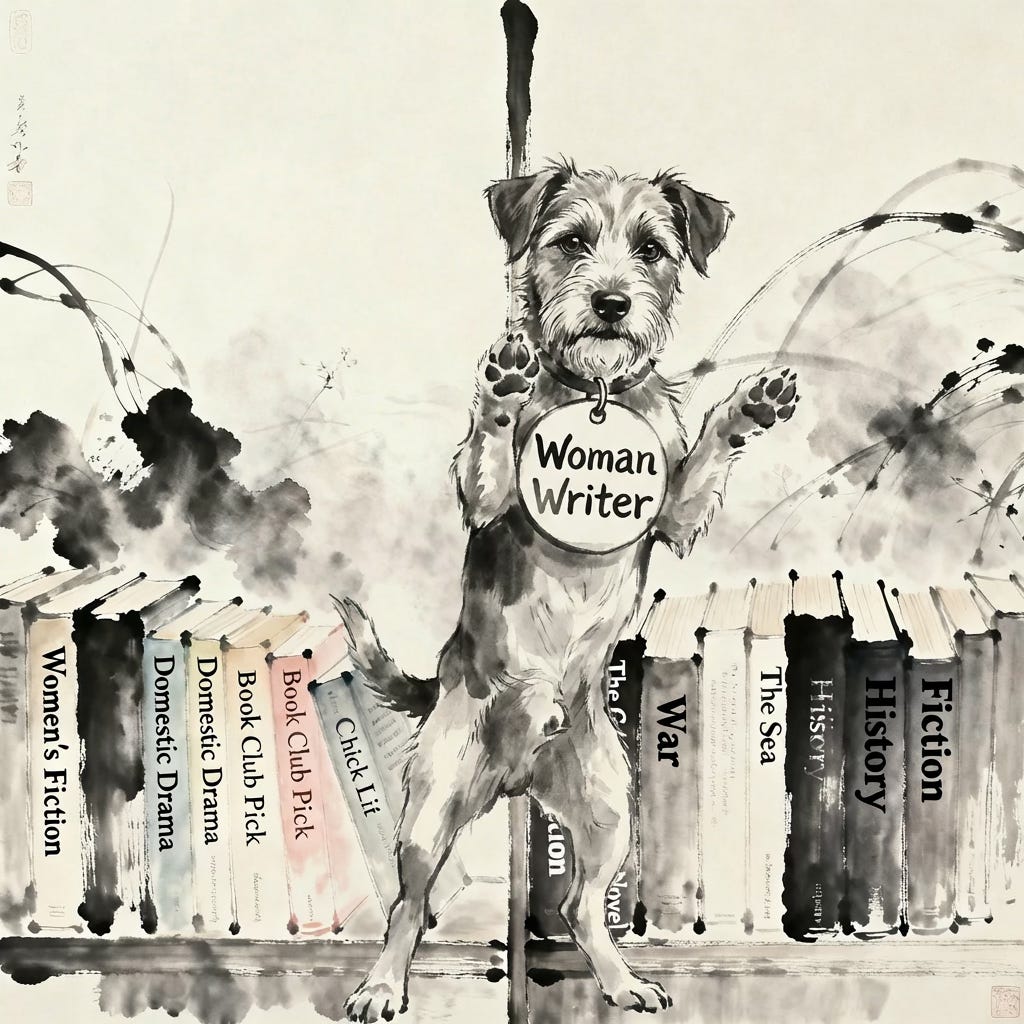
It is a truth universally acknowledged that if you want to write Women’s Fiction—that is to say, stories about women read mostly by women—which are also considered to be “big books,” deeply intuitive and revelatory about the human condition, you must be in want of a penis.
Gentle reader, some of you already know why I chose this sentence construction, but more about this later.
It takes me some time to get to the point. I am, after all, a woman writer—that thing so eloquently described by Samuel Johnson, talking about a female preacher, like a dog walking on its hind legs: “It is not done well, but you are surprised to see it done at all.” Johnson was of this opinion in 1763, but there are many who still are of this opinion when it comes to women being serious writers.
Hence the term “Women’s Fiction.” This is the upcycled, less infantilized description of the genre once called “chick lit.”
I write Women’s Fiction.
Sometimes, I am honored for it: “Few are the equal of Mitchard at understanding the power and perplexity of human emotion.” Sometimes, I am derided for the same thing (and I must confess that I really do love this comment from a review because it is just so deliciously cruel): “Mitchard writes competently about things everyone already knows.”
Tom Perrotta writes Women’s Fiction too. I really like Tom Perrotta’s books, which include MRS. FLETCHER, LITTLE CHILDREN, THE ABSTINENCE TEACHER. I admire them.
I also admire what critics say about his work.
Here’s one assessment: “Tom Perrotta is renowned for creating deeply human, flawed, and often suburban characters, with a particular focus on the complex, messy lives of middle-aged women navigating identity crises, sexual desire, and societal expectations. His work frequently examines women who are struggling to find purpose or autonomy, often balancing on the edge of ‘bad mommy’ archetypes with a mixture of satire and empathy.”
Cue the dog standing on its hind legs again—but in a good way.
In other words, how can this known cis male so deeply understand the hidden lives of women? He’s just so darned good, is how, I guess. And because he is a fella, he is unburdened of the concerns of women who write women’s fiction, which include deeply internalized cultural misogyny.
Could his presumption in writing about women’s interior lives be termed cultural appropriation?
If Perrotta were writing about the challenges facing Indigenous women and men working at fish-packing factories (maybe you could title it something like … CANNERY ROW?), he would have one toe over the cultural-appropriation line, but since these women are suburban women of Anglo extraction and middling means, it’s okay.
To characterize Women’s Fiction, I want to paraphrase what Liz Kay once wrote in Lit Hub: these are stories in which much of the content is instructive. Kay writes that this precept holds true even in entertainment directed at women, and even in nonfiction directed at women, i.e., “self-help.”
In other words, in Women’s Fiction we read about characters learning how to remember, how to forget, how to come to terms with the past, how to come to terms with the future—how to be beautiful, how to be thin, how to have value, and/or (gasp!) in the most elevated of these narratives, how not to care about that stuff. (Check out the quote that closes this little article-ette by this authoress, yours truly, from Charlotte Brontë’s JANE EYRE, for our Charlotte was a feminist of power and glory 126 years before the Supreme Court opined that the decision about continuing a pregnancy was between a woman, her conscience, and, if you will, her soul—but never mind that, that decision was repented of in 2022 and now, again, a woman’s private life is a public matter … and yes, I know that was quite a digression, but at least I wasn’t talking about the color scheme that my best friend’s daughter is choosing for her wedding …)
Female characters in Women’s Fiction are taking mostly emotional journeys through major life changes, exploring family, friendship, resilience—people on a journey to fix themselves.
The character may transform her life.
There is no category for Men’s Fiction (which is referred to as “Fiction”) because in Men’s Fiction, the character, most often a man, transforms not just his life, but the world (or Education, or Government, or the Wild West …). A real man, and presumably a real-man author, must have, Ernest Hemingway is said to have said, his war or his sea voyage. (And yet, the Irish bard Brendan Behan, a staunch admirer of Hemingway’s hyper-masculinized writing and persona—which I sometimes am, as well—is said to have said that only America could have produced Ernest Hemingway and not gotten the joke …)
But I digress. Again.
The point is (and you knew that one was coming) what women write about in Women’s Fiction is sometimes unfairly and stupidly disrespected because, indeed, it is about real life (i.e., “the things everyone already knows”). Everyone may already know, but few understand … ask any psychiatrist.
We read (and write) stories such as these to understand the most important arena (or bull ring) of all, the home. If you have a good one, you have a good chance of being okay. If you have a bad one, you don’t have as good a chance of being okay (ask any psychiatrist). Still, reading about the challenges to being okay that similar others (and I am not going to use the term “relatable” because I don’t think it is a word, or if it is, it should not be …) have endured and conquered can help everyone.
Dare I say, it can change the world.
Am I defensive because I have not had my sea voyage or my war, but have only had the chopped salad and the veggie burger without the bun? Am I defensive because I write Women’s Fiction (“chick lit”) and not Big-F Fiction (“dick lit”)?
Maybe.
Others before me were too.
In her time, Jane Austen, that shrewd and sly chronicler of real life, was chided for not writing about “important things.” (See the opening, way back up there, my own tiny homage to Austen’s PRIDE AND PREJUDICE.) She was entirely aware that some considered her a lightweight. Beneath her dulcet words, good manners, and slight appearance was a core of steel. She knew that what she wrote about marriage and society and class and culture was important. And she kept on keeping on.
There were more popular male novelists in Jane Austen’s time, among them Horace Walpole.
Yes, right, him. My point exactly.
So am I defensive? I defend what I write not just as important but as urgent … in our time (as it were). In fact, all stories are about how human beings confront those pivots in life in which we struggle to understand our fear, our mortality, our failure, our courage or the lack, our love or the lack. There would otherwise be no stories at all, only the chopped salad and the veggie burger (hold the bun).
Now here is that promised quote from JANE EYRE … just to see how a sister said it once upon a time:
“No sight so sad as that of a naughty child,” he began, “especially a naughty little girl. Do you know where the wicked go after death?”
“They go to hell,” was my ready and orthodox answer.
“And what is hell? Can you tell me that?”
“A pit full of fire.”
“And should you like to fall into that pit, and to be burning there forever?”
“No, sir.”
“What must you do to avoid it?”
“I must keep in good health and not die.”
― Charlotte Brontë, Jane Eyre
Your opening line kills me. :-D
I could relate to so much of this.
You hit it out of the park. Thank you.
Love, Beth Gutcheon